
Innovation
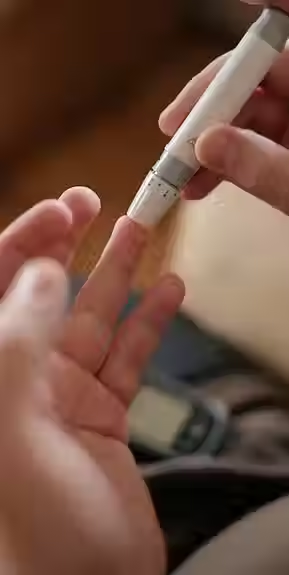
Diabetes Management (Medical Technology)
From Start-up to International Market Success
The challenge: A Swiss start-up had developed an innovative diabetes management product and now needed a solid business case for strategic investors. The key questions: How does market access work in Germany, France, the UK, the USA and China? When will health insurers cover the cost?
The solution: We first validated the patient benefit through conversations with healthcare professionals and patients. We then assessed market viability in the target regions and spoke with local decision-makers. Acting as "translators," we turned complex country data into a compelling investor story. A strategic investor acquired the company and is now launching the product in international markets, building on the strategic foundation we provided.

Home Appliances
Product Development Based on Real Customer Insights
The challenge: A home appliance manufacturer wanted its product innovations to do more than impress technically. They needed to work in people's everyday lives. What unconscious needs exist? What sets us apart from the competition?
The solution: We used ethnographic research to understand consumers' daily lives and routines. In-home product tests in real usage settings produced authentic feedback, and competitor observation identified opportunities to stand out. As a partner working at eye level with the client, we brought engineering, marketing and senior management together. The insights went directly into development. The results were better functionality, improved ergonomics, a sharper market strategy, data-driven pricing and clearer communication across advertising, instructions and apps.

Personal Protective Equipment (PPE)
How E-Mobility Is Changing Occupational Safety
The challenge: E-mobility is transforming the automotive industry. A leading PPE manufacturer needed to understand how workplaces and occupational safety requirements are changing. What new risks are emerging? How will demand develop?
The solution: We set up a 360-degree analysis combining desk research, in-depth interviews with carmakers, suppliers and repair shops, trend scouting at the IAA, factory visits and expert discussions. We gave concrete recommendations for product design, such as how to handle high-voltage systems. We also modelled how workplaces will change and forecast demand volumes. With this, the client shaped its portfolio precisely, planned with confidence and positioned itself early as a partner to the automotive industry.

Licensed Products (Confectionery)
Unlocking New Moments of Indulgence
The challenge: A confectionery brand with a long heritage wanted to launch new product categories, from desserts to ice cream to cakes. The question: which product ideas truly fit the brand, and which brand story and packaging design would win people over without alienating loyal customers?
The solution: We conducted a nationwide online survey. Respondents were split evenly between loyal buyers, brand-aware consumers, and chocolate lovers who didn't yet know the brand. We tested two brand stories, four design routes, and a range of new product ideas, some benchmarked directly against competitors. This revealed where the brand could afford to take risks and where it needed to stay rooted in its heritage. The result was a solid foundation for deciding which products and which look the license should launch with, and how the brand can gradually skew younger.
Market Research

Electric Motorcycles
From Raw Exhaust Sound to Electric Passion
The challenge: An electric motorcycle manufacturer was preparing to launch in Germany. The question: How do you win over bikers for whom the sound and vibration of a combustion engine are part of the DNA of riding? A false start would have meant rejection by the community.
The solution: We designed a multi-stage research process meant to go deeper than classic market research. We recruited active bikers for an online community to discuss their everyday experiences and what riding means to them emotionally. But we didn't stay online. We visited several riders at home, joined them on rides and experienced motorcycle culture first-hand. This let us identify the real emotional drivers and build meaningful customer profiles. The positioning that came out of this built a bridge to existing values instead of rejecting them. The result: a successful market launch, embraced by the community.

In-Game Advertising (Food Retail)
When advertising becomes part of the game
The challenge: A large German grocery retailer wanted to try a new advertising format: audio ads in mobile games. The goal was to raise awareness of the retailer's own loyalty program. The underlying questions: Does in-game advertising actually land with players? And in which game does it work best?
The solution: We designed a quantitative online study among people who play mobile games regularly and share in household purchasing decisions. Using matched test groups, the same spot ran in three different games. This revealed just how strongly the game itself shapes the ad's impact: the voice-over and length were identical across all three, yet the spot was perceived very differently depending on the game. The results were clear recommendations on which games, and which type of reward, work best for the new format.
Strategy

Customer Relationship Management in Plant Engineering
Strategic Optimization Through Data-Driven Customer Analysis
The challenge: An international manufacturer of industrial components needed to understand where customer relationships were at risk. What will customers expect in the future from technology, service and advice? Where is there a risk of losing them?
The solution: We ran systematic in-depth interviews at every level of the hierarchy, from operational management to the C-suite. This breadth was key to getting the full picture. In strategic workshops, we turned the insights into prioritized action areas, concrete projects and measurable KPIs. Ongoing monitoring made sure the measures worked. The company spotted threats to its relationships early, made targeted improvements and strengthened long-term business relationships with offers tailored to customer needs.
